

Block Blast!
HungryStudio
I spent time with Block Blast! as a quick, touch-friendly puzzle game, and my first impression was simple: it is easy to understand, but not always easy to play well. The idea is built around placing block shapes so they form complete lines and disappear. That familiar formula makes it possible to begin immediately, while the open-ended placement gives each move more weight than the cheerful presentation might suggest.
What makes it useful in everyday life is its low commitment. I can pick it up for a short break, make a few decisions, and put it down without needing to remember a story or manage a complicated menu. It is a free game from HungryStudio, rated for Everyone, and it belongs firmly in the casual puzzle category. Its store summary presents it as suitable for offline relaxation, which matches the kind of situation where I found it most comfortable: waiting somewhere, taking a pause between tasks, or looking for something to do without a long setup.
How the block puzzle feels after more than a few rounds
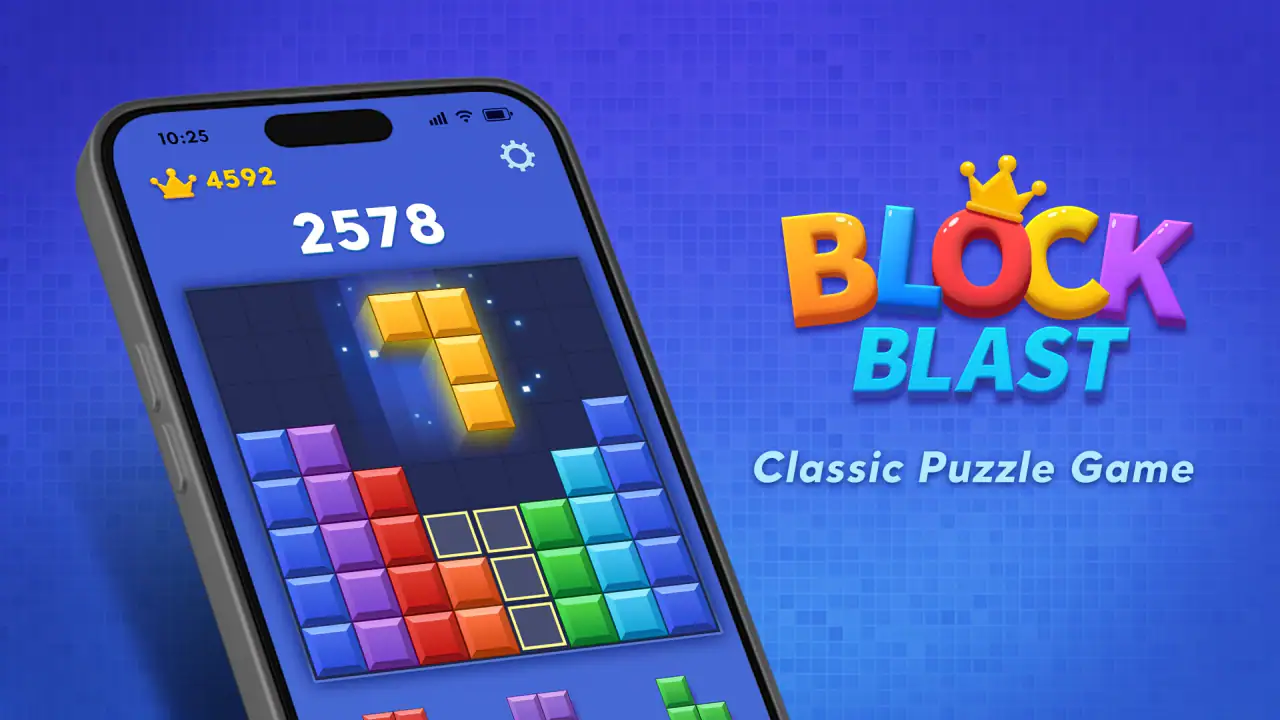
The opening is deliberately approachable. Shapes are familiar, the board is visually readable, and the basic objective becomes clear through play rather than a lengthy tutorial. I did not need a rulebook to understand what I was meant to do. That matters on a phone, where a puzzle that explains too much before letting me play can feel like work.
Related News

Block Blast!: The Puzzle Game Reflecting Our Digital Lives

Canva on Mobile Is Excellent for Most Creators, but Not Every Workflow

Google Lens: Your Pocket Guide to the World
The interesting part begins when the board stops offering obvious placements. A move can solve the immediate problem while creating a worse one for the next pieces. I learned to look beyond the line I could clear right now and preserve open areas for awkward shapes. That small change in thinking separates a careless round from a satisfying one.
I especially like the way the game turns empty space into a resource. A nearly full board is not automatically good, because a narrow gap may be useless when the next shape arrives. Leaving a broad, flexible area can be more valuable than clearing a line as soon as possible. This is one of the less obvious lessons in the game, and it gives the simple controls more depth than the short description suggests.
Related News

Why WhatsApp Messenger Still Makes Everyday Communication Feel Easy

Jurassic World: The Game Is the Better Dino Tycoon for Strategic Players

Threads in Real Life: Who Should Join, Lurk, or Leave

How SHEIN Turned Shopping Into an Endless Content Feed

How to Make Fortnite Feel Smarter on Mobile

Should You Switch to Microsoft Outlook on Mobile?
My practical advice is to avoid filling the board from one side without a plan. When I kept building a dense wall, I often left isolated holes that could not accept the shapes I needed. Spreading placements with intention gave me more options. I also found it helpful to treat large pieces as future tools rather than obstacles: placing them too early may remove the space needed for smaller pieces, while saving a suitable area can turn a difficult board around.
That flexibility is also where the pressure comes from. The game does not need complicated enemies or elaborate missions to create tension. The pressure comes from seeing the available space shrink and knowing that a poor placement cannot simply be ignored. For players who enjoy planning several moves ahead, this is the strongest part of the experience.
A good fit for short breaks, not every kind of player
In a realistic everyday scenario, I would use it while waiting for an appointment or during a short commute when I wanted something more engaging than scrolling. A round can begin quickly, and I can focus on one decision at a time. It also works well as a quiet wind-down activity because the rules are stable and the attention required is manageable once the board becomes familiar.
Gallery
It is less suitable if I want a rich adventure, a strong narrative, or a puzzle campaign with carefully authored stages. This is a repeatable board challenge rather than a story-driven game. Someone who prefers word puzzles, logic riddles, or level-based objectives may find the open-ended format too similar from one session to the next.
I would also avoid recommending it as the main game for someone who dislikes losing progress through a single bad decision. The simplicity can make mistakes feel personal: I know exactly which placement created the problem. That can be motivating, but it can also become irritating when I am tired and only wanted a relaxed distraction.
What progress really means here
The sense of progress is closely tied to improving my own decisions. Instead of relying on a long list of unlocks or a developing story, I became better at recognizing dangerous gaps, keeping the center usable, and refusing tempting placements that offered an immediate clear. That makes the game rewarding for players who enjoy self-improvement, but less compelling for anyone who needs frequent new content to stay interested.
There is a subtle trade-off between playing safely and chasing a larger result. Clearing lines early keeps the board comfortable, but conservative play can limit later possibilities. Taking a calculated risk may create a stronger position, yet one unlucky shape can punish that choice. I found the best approach was not to chase every possible clear. I tried to preserve options first and only accepted aggressive moves when the remaining space gave me a reasonable recovery path.
This also answers a question many new players have: should every available line be cleared immediately? In my experience, no. A clear is useful, but it should be judged by what it leaves behind. A smaller clear that opens several placement routes can be better than a larger-looking move that creates disconnected pockets. Thinking about the next two or three placements, rather than only the current one, made my rounds noticeably more consistent.
The game’s free entry is important here. I could try the core puzzle without paying first, which makes it easy to decide whether the repeating format suits me. The listed in-app purchase range runs from $4.99 to $49.99 per item. That is enough of a spread that I would personally review any purchase screen carefully before confirming anything, especially if I were handing the phone to a child.
I do not treat the existence of purchases as proof that the game is unfair. The purchase information establishes that optional paid items are present, but it does not by itself explain how they affect play. I would therefore approach spending as a personal choice rather than assume that paying is necessary to enjoy the basic puzzle. The sensible habit is to play the free experience first and only consider a purchase if its purpose is clear and genuinely useful to you.
Fairness, competition, and the limits of comparison
Block Blast! is easiest to judge as a personal puzzle rather than a traditional competitive game. My enjoyment comes from making better placements and extending a run, not from controlling a character or defeating another player in a tactical match. That changes what fairness means. I care less about symmetrical combat and more about whether the rules remain understandable and whether my decisions feel meaningful.
Compared with a classic match-three game, this format gives me more direct control over the board. I am not simply swapping neighboring pieces and waiting for a chain reaction. I choose where each shape goes, so planning and spatial judgment matter more. Compared with a falling-block game, the pace feels less frantic because pieces do not force themselves downward while I think. That makes it friendlier for casual play, though players who enjoy speed and reflexes may find it calmer than they want.
It also differs from a traditional puzzle book or a fixed collection of logic levels. Those alternatives often provide a known solution or a carefully designed endpoint. Here, the challenge is more about adapting to the current arrangement and managing risk over time. I prefer this when I want replayability, but I would choose a level-based puzzle if I wanted a clear sense of completion.
For competitive-minded players, the important question is whether the game offers enough transparent structure to support serious comparison. I would not assume that a personal score automatically represents skill in the same way as a head-to-head match. Board situations and available shapes influence the decisions in each run, so I see the competitive appeal as self-challenge first. If your priority is ranked multiplayer with clearly defined opponents, another puzzle game may be a better match.
One fair way to use it is to set your own rules. I sometimes focus on survival and clean board management instead of chasing a dramatic score. On another session, I may deliberately practice keeping one large open area. This turns the game into a small training exercise rather than a vague attempt to beat an earlier result. It also reduces the temptation to treat every round as a test of luck or worth.
What I would check before spending
The current version is 8.8.6, and the game supports devices running Android 6.0 or later. Those details make it easier to judge basic compatibility before installing. It is available at no upfront price, but the presence of in-app purchases means I would still use normal purchase safeguards on a shared device.
The age rating of Everyone makes the presentation broadly accessible, yet that should not replace supervision for younger players who can access paid items. I would explain that the game can be played for free and that any purchase needs permission. That is a practical boundary, not a criticism of the puzzle itself.
The large audience is notable: the game has passed over 500 million installs, with an average rating of 4.8 from around 3.4 million ratings. Those figures show that the format has reached many players, but popularity does not guarantee that it will fit your habits. I would still base the decision on whether you enjoy open-ended spatial planning and repeated rounds.
There are also details I would not pretend to know from the basic product information alone. The purchase range tells me the available items can vary considerably in price, but it does not tell me enough to judge every item’s value or how each one changes the experience. Rather than guessing, I would read each confirmation screen carefully and avoid buying simply because a difficult board has become frustrating.
The same cautious approach applies to progress pressure. The game can encourage me to keep trying after a poor round because the next placement might improve everything. That is normal for a score-based puzzle, but I think it is healthier to stop when the challenge stops feeling enjoyable. A short timer or a personal session limit can keep the game in its intended role as a break instead of turning it into an obligation.
Small habits that make the board easier to manage
My most useful habit is to inspect all available shapes before placing the first one. I look for the piece that has the fewest possible homes and protect a space for it. Flexible shapes can usually wait, while an awkward long or irregular piece may become impossible if I fill the wrong area first.
I also avoid creating single-cell holes unless I already know how they can be filled. A clean-looking board is not necessarily a healthy board. Large connected spaces give me more recovery options, while isolated gaps turn future pieces into forced guesses. This is a simple principle, but it changed how I viewed attractive short-term clears.
Another useful technique is to alternate between clearing and preparing. If I only clear lines, I may leave the board fragmented. If I only prepare open space, I may allow clutter to grow. I try to make one move that improves immediate room and another that keeps future placements flexible. The exact rhythm changes from board to board, but the idea prevents me from playing every turn with the same instinct.
Finally, I treat a nearly full board as a planning signal rather than an automatic failure. I pause, identify the piece most likely to cause trouble, and search for a placement that preserves at least one broad route. Even when the round cannot be saved, this habit helps me understand why it ended. That makes losses informative instead of merely annoying.
My trust verdict after using it
HungryStudio has made a puzzle that is immediately readable but capable of rewarding careful thought. I like that the main challenge comes from placement choices rather than complicated controls. The free starting point lowers the barrier to trying it, and the offline-friendly positioning makes sense for moments when I want a distraction without building a long session around it.
My reservations are mostly about fit and spending discipline. Repeated board play can feel narrow if I need stories, missions, or constant novelty. The listed purchases also mean I would not hand the device to a child without purchase controls. Because the available purchase information does not explain the role or value of every item, I would make decisions slowly instead of assuming that payment improves the puzzle.
For me, the strongest reason to recommend it is the balance between calm controls and surprisingly demanding space management. It is a good choice for a person who wants a familiar puzzle that can occupy five quiet minutes or invite a longer attempt at improvement. I would skip it if you want direct multiplayer competition, a narrative journey, or a fixed series of handcrafted solutions.
Overall, I trust it as a straightforward free puzzle to try, provided I keep expectations realistic and treat purchases carefully. Its broad audience and strong average rating are encouraging, but the real test is personal: if arranging shapes, preserving open space, and learning from a crowded board sounds satisfying, this game is worth installing. If that loop already sounds repetitive, the popularity will not change the underlying experience.
FAQs for Block Blast!
What is Block Blast! and how does it work?
Block Blast! is a puzzle game available on both Android and iOS platforms. The game involves placing and matching blocks to clear lines and earn points. As you progress through levels, the difficulty increases with more complex block arrangements. It’s designed to be intuitive yet challenging, making it suitable for players of all ages.
Is Block Blast! free to play, and are there in-app purchases?
Yes, Block Blast! is free to download and play. However, it offers in-app purchases for players who wish to enhance their gaming experience. These purchases can include additional lives, special power-ups, or ad-free gameplay. Players can enjoy the game without spending money, but purchases can provide extra benefits.
What are the key features of Block Blast!?
Block Blast! features a sleek and colorful design, engaging sound effects, and smooth gameplay. Key features include multiple game modes, daily challenges, and leaderboard integration to compete with friends. The game also offers power-ups and special blocks that add layers of strategy to the puzzles, keeping the gameplay fresh and exciting.
Are there any ads in Block Blast!?
Yes, Block Blast! contains ads, which help support the free version of the game. These ads may appear between levels or during gameplay breaks. Players who prefer an ad-free experience have the option to purchase an ad-free version through in-app purchases. This option enhances the gameplay by removing interruptions.
Does Block Blast! require an internet connection to play?
Block Blast! can be played offline, allowing users to enjoy the game without an internet connection. However, certain features, such as leaderboards, daily challenges, and in-app purchases, require an internet connection to function. Offline play is perfect for users who want to enjoy the game on the go without using mobile data.
Pros
- Engaging and addictive gameplay.
- Intuitive controls for easy play.
- Vibrant graphics and sound effects.
- Regular updates with new levels.
- Offline mode available for play.
Cons
- Contains in-app purchases.
- Ads can be intrusive.
- Limited customization options.
- Requires frequent updates.
- Battery consumption is high.


